Frédéric Bertrand
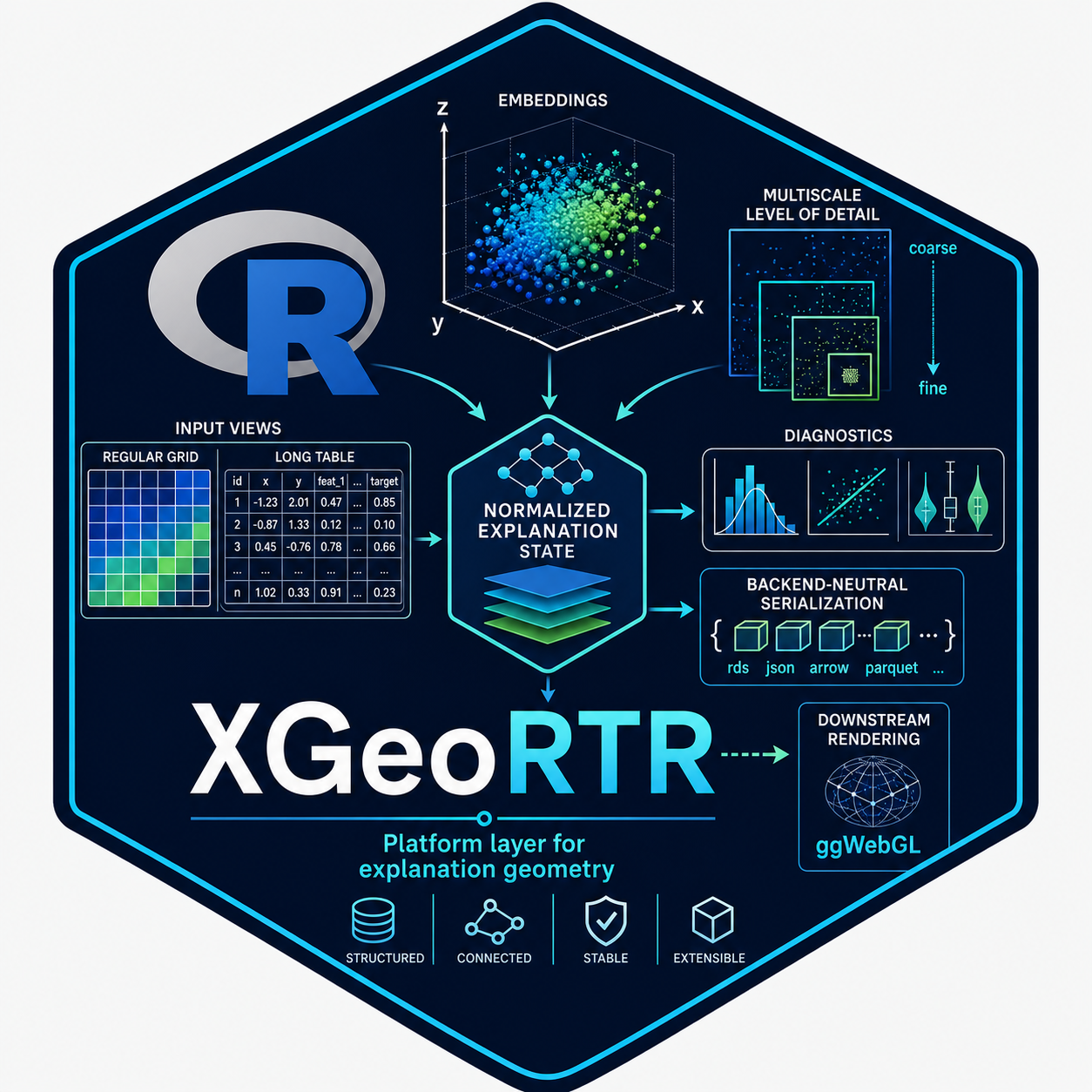
XGeoRTR is explainable geometry backend infrastructure for R workflows that need reusable analytic state rather than package-specific presentation code. It owns geometry-aware state, embeddings, diagnostics, multiscale summaries, selection state, selected backend tables, and JSON state exchange.
Downstream packages such as shapViz3D, rTDA3D, and renderer frontends can consume xgeo_state or exported backend tables without XGeoRTR taking ownership of their display, interaction, or use-case presentation layers.
Role in GeoXGL
XGeoRTR is the geometry/state backend of the GeoXGL ecosystem, a modular R/WebGL stack for scalable statistical graphics, explanation geometry, and scientific visualization.
Within GeoXGL:
-
XGeoRTRowns backend-neutral explanation geometry,xgeo_state, embeddings, diagnostics, level-of-detail summaries, selection state, public backend tables, and JSON state exchange. -
ggWebGL, available as a CRAN renderer frontend, owns browser-native WebGL rendering, widgets, viewport interaction, shader execution, and static export surfaces. -
shapViz3Dand other use-case packages own domain semantics and downstream layout mappings.
This package does not own rendering, viewport orchestration, camera control, canvas management, shader execution, widget construction, visual themes, or export surfaces. Those responsibilities remain in renderer frontends such as ggWebGL.
Compatibility claims should be read through the GeoXGL interface contract rather than through renderer internals.
Current scope and future work
Current scope: backend state, coercion, embeddings, diagnostics, level-of-detail summaries, selections, explanation tables, point-value tables, regular-grid tables, and JSON serialization.
Future/prototype scope: topology-specific reasoning, prediction-regime path semantics, and large-scale performance claims should be presented only when supported by concrete downstream examples or benchmark artifacts. Causal explanation is outside the current package scope.
Main features
- Canonical backend object:
xgeo_state() - Coercion:
as_xgeo_state() - State operators:
- Backend-neutral accessors:
- Backend-neutral tables:
- Serialization:
Installation
For local development from checked-out repositories:
install.packages(c("cli", "jsonlite"))
devtools::load_all(".")
Optional packages:
-
uwotfor optional UMAP embeddings -
knitr,rmarkdown, andpkgdownfor documentation work
Build backend state
library(XGeoRTR)

demo_path <- system.file("extdata", "spatial_demo.csv", package = "XGeoRTR")
demo_tbl <- utils::read.csv(demo_path, stringsAsFactors = FALSE)

state <- as_xgeo_state(
  demo_tbl,
  x_col = "x",
  y_col = "y",
  z_col = "z",
  value_col = "value",
  feature_col = "feature",
  method = "spatial-field-demo",
  meta = list(source = "synthetic-demo", sample_id = "grid-01")
)

state <- compute_xgeo_embedding(state, method = "pca", source = "points", dims = 2)
state <- set_active_embedding(state, "pca_points")
state <- compute_xgeo_diagnostics(state, embedding = "pca_points", source = "points", k = 3)
state <- build_xgeo_lod(state, embedding = "pca_points", levels = c(8L, 16L), auto_threshold = 10L)
state <- set_xgeo_selection(state, point_ids = state$indices$point_ids[[1]])

summary(state)
Popular R workflow examples
The file inst/examples/popular_r_workflows.R shows how outputs from common R workflows can be standardized as backend explanation geometry:
-
stats::lm()onmtcars -
stats::glm()onmtcars -
stats::kmeans()oniris -
stats::prcomp()onUSArrests - optional
rpart::rpart()oniris, whenrpartis installed - matrix-to-grid conversion using
datasets::volcano
The examples produce xgeo_state objects, compute PCA embeddings, diagnostics, and LOD summaries, expose long and point-level backend tables, and demonstrate JSON serialization through tempfile().
source(system.file("examples", "popular_r_workflows.R", package = "XGeoRTR"))Write and reload state
out_json <- tempfile(fileext = ".json")
write_xgeo_state(state, out_json)
restored_state <- read_xgeo_state(out_json)
Build downstream tables
long_tbl <- xgeo_explanation_table(state)
point_tbl <- xgeo_point_values(state)
grid <- xgeo_regular_grid(point_tbl)
Use-case packages should consume these public tables instead of inspecting internal ingestion objects. For example, a Shapley-oriented package can consume selected explanation tables, while a topology-oriented package can consume point and regular-grid summaries as backend inputs.
Supported package claims
The package directly supports these backend capabilities:
- canonical backend state:
xgeo_state - tabular-to-state ingestion:
as_xgeo_state - embedding and diagnostic operators for geometry-aware workflows
- multiscale LOD summaries with
build_xgeo_lod - selected explanation, point-value, and regular-grid tables
- backend JSON exchange with
write_xgeo_stateandread_xgeo_state - downstream-consumer readiness for packages such as
shapViz3D,rTDA3D, and renderer frontends
Downstream use-case consumers
XGeoRTR does not ship use-case-specific presentation assets. Shapley-specific semantics belong in Shapley-oriented downstream packages, topology-specific semantics belong in topology-oriented downstream packages, and display orchestration belongs in renderer frontends.
What XGeoRTR provides is the backend path that downstream consumers can use:
-
as_xgeo_state()standardizes the long tables -
set_xgeo_selection()controls subset state upstream -
xgeo_explanation_table(),xgeo_point_values(), andxgeo_regular_grid()expose renderer-neutral tables downstream -
compute_xgeo_embedding(),compute_xgeo_diagnostics(), andbuild_xgeo_lod()provide optional backend context without taking over presentation - renderer frontends such as
ggWebGLcan convertxgeo_stateobjects or exported backend tables into display-specific WebGL specifications without moving rendering responsibilities intoXGeoRTR
The backend-only example below shows the intended consumption pattern for a downstream package. If the downstream data source is unavailable, the same example falls back to the bundled spatial_demo.csv so the backend workflow still runs without a SHAP or renderer dependency.
source("inst/examples/downstream_shapviz3d_state_tables.R")Scope
XGeoRTR produces backend state and computation products; downstream packages decide how to present or interact with those products.
- XGeoRTR: backend geometry/state semantics, operators, selected tables, and serialization
- Downstream consumers: Shapley presentation, TDA workflows, renderer adapters, and front-end interaction
The frozen package boundary is documented in INTERFACE_FREEZE.md. Public XGeoRTR objects and serialized payloads must remain free of display-system fields such as scene, layer, viewport, camera, canvas, theme, shader, widget, and export surface metadata.