
Frédéric Bertrand
SelectBoost.quantile adapts the SelectBoost idea to sparse quantile regression. The package builds correlation neighborhoods, perturbs correlated predictors with a directional sampler inspired by the original SelectBoost internals, refits penalized quantile regression models on the perturbed designs, and aggregates variable-selection frequencies across a path of correlation thresholds.
The current package already supports:
- matrix and formula interfaces,
- single- and multi-
tauworkflows, - tau-aware screening for
p > nsettings, - stronger penalty tuning through one-standard-error selection and lambda inflation,
- complementary-pairs stability selection,
- neighborhood capping for high-dimensional correlated designs,
- hybrid support extraction that combines path stability and fitted effect size,
- benchmark helpers for validation studies.
The package should still be read as a methodological prototype: the workflow is usable and documented, but the quantile-regression adaptation is still being validated and refined.
Start with vignette("getting-started", package = "SelectBoost.quantile") for the main workflow, then use vignette("validation-study", package = "SelectBoost.quantile") for the shipped benchmark comparisons.
Installation
You can install the development version of SelectBoost.quantile from GitHub with:
remotes::install_github("fbertran/SelectBoost.quantile")From a local source checkout, use:
devtools::install()Main workflow
For each correlation threshold c0, selectboost_quantile():
- normalizes the design as in the original
SelectBoostworkflow, - builds correlation neighborhoods,
- fits a sign-aligned directional model to each neighborhood,
- perturbs the predictors in the sample hyperplane,
- refits sparse quantile regression,
- aggregates the selection frequencies across perturbations and stability subsamples.
The resulting frequency path can then be summarized, plotted, or thresholded into a stable support.
Example: matrix interface
library(SelectBoost.quantile)

sim <- simulate_quantile_data(
  n = 100,
  p = 20,
  active = 1:4,
  rho = 0.7,
  seed = 1
)

fit <- selectboost_quantile(
  sim$x,
  sim$y,
  tau = 0.5,
  B = 6,
  step_num = 0.5,
  screen = "auto",
  tune_lambda = "cv",
  lambda_rule = "one_se",
  lambda_inflation = 1.25,
  subsamples = 4,
  sample_fraction = 0.5,
  complementary_pairs = TRUE,
  max_group_size = 10,
  seed = 1,
  verbose = FALSE
)

print(fit)
#> SelectBoost-style quantile regression sketch
#>   tau: 0.5
#>   perturbation replicates: 6
#>   c0 thresholds: 5
#>   predictors: 20
#>   grouping: group_neighbors
#>   max group size: 10
#>   screening: none
#>   stability selection: 4 draws at fraction 0.5 (complementary pairs)
#>   tuned lambda factor: 0.7789 (cv, one_se)
#>   top mean selection frequencies:
#>    x2    x1    x3    x4   x17    x5
#> 0.883 0.875 0.771 0.688 0.583 0.579
summary(fit)
#> Tau: 0.5
#> Stable support threshold: 0.55
#> Selection metric: hybrid
#> Variables above the threshold:
#> [1] "x2" "x1" "x3"
#> Top summary scores:
#>    x2    x1    x3    x4   x13   x17    x5   x14   x12   x10
#> 0.871 0.863 0.686 0.513 0.189 0.164 0.080 0.069 0.044 0.022
support_selectboost_quantile(fit)
#> [1] "x2" "x1" "x3"
plot(fit)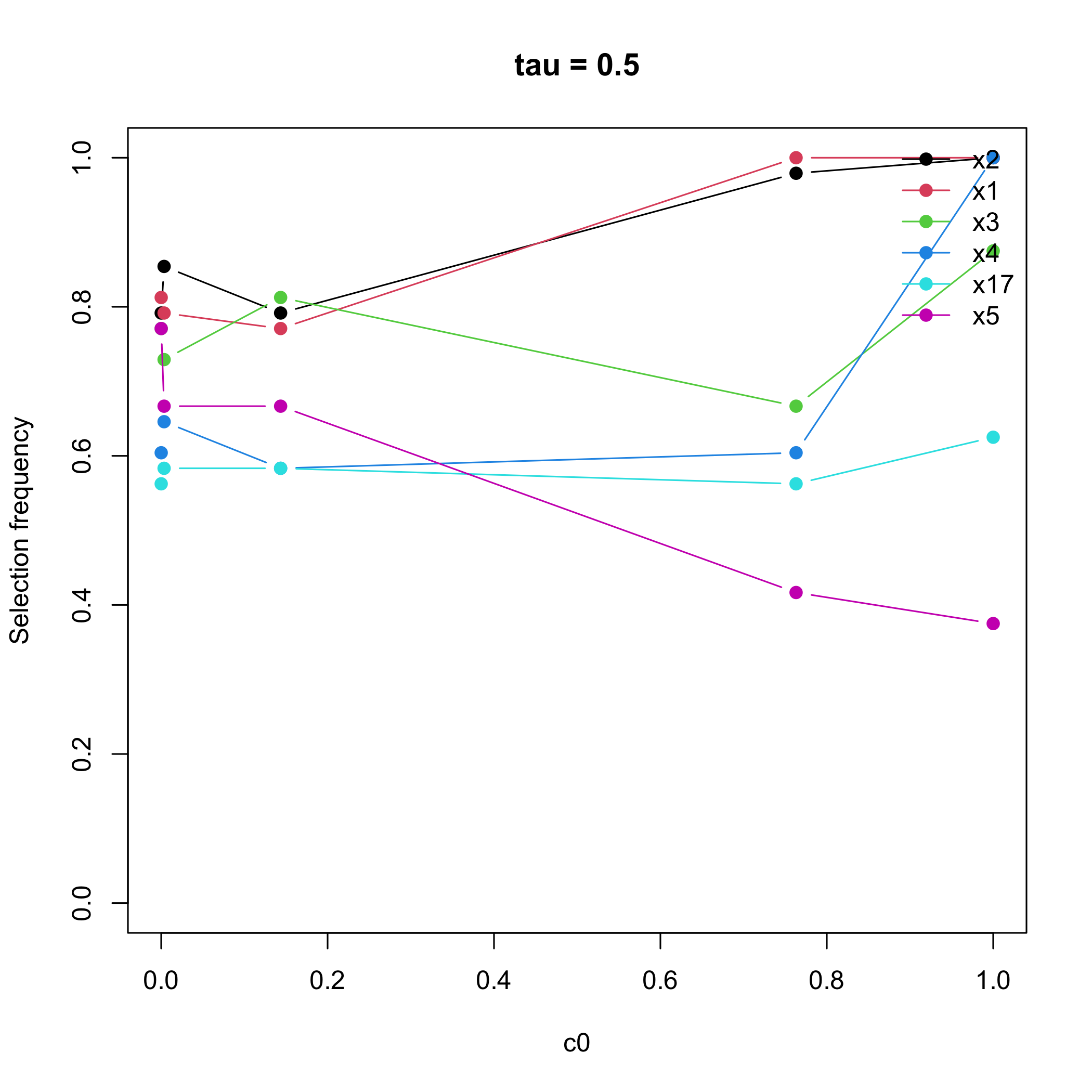
Selection-frequency paths for the six variables with the highest mean selection frequency.
Example: formula interface and multiple quantiles
dat <- data.frame(y = sim$y, sim$x)

fit_formula <- selectboost_quantile(
  y ~ .,
  data = dat,
  tau = c(0.25, 0.5, 0.75),
  B = 4,
  step_num = 0.5,
  tune_lambda = "bic",
  seed = 2,
  verbose = FALSE
)

print(fit_formula)
#> SelectBoost-style quantile regression sketch
#>   tau: 0.25, 0.50, 0.75
#>   perturbation replicates: 4
#>   c0 thresholds: 5
#>   predictors: 20
#>   grouping: group_neighbors
#>   screening: none
#>   tuned lambda factors: 1.0000, 0.5322, 1.0000
#>  tau = 0.25: top mean selection frequencies
#>   x1   x2   x3  x20
#> 0.95 0.85 0.85 0.85
#>  tau = 0.5: top mean selection frequencies
#>  x17   x3   x4   x5
#> 0.95 0.90 0.90 0.90
#>  tau = 0.75: top mean selection frequencies
#>   x1   x3   x4  x16
#> 0.85 0.80 0.80 0.80
summary(fit_formula)
#> SelectBoost quantile summary
#>   tau values: 0.25, 0.50, 0.75
#>   selection metric: hybrid
#>  tau = 0.25: 3 variables above threshold
#>  tau = 0.5: 3 variables above threshold
#>  tau = 0.75: 4 variables above threshold
Penalty tuning
The package exposes the penalty-tuning stage directly through tune_lambda_quantile(). This is useful when the tuning decision itself needs to be inspected.
tuned <- tune_lambda_quantile(
  sim$x,
  sim$y,
  tau = 0.5,
  method = "cv",
  rule = "one_se",
  lambda_inflation = 1.25,
  nlambda = 6,
  folds = 3,
  repeats = 2,
  seed = 3,
  verbose = FALSE
)

print(tuned)
#> Quantile-lasso tuning
#>   tau: 0.5
#>   method: cv
#>   rule: one_se
#>   lambda inflation: 1.25
#>   folds: 3
#>   repeats: 2
#>   selected factor: 0.6866
#>   score: 0.49975
#>   standard error: 0.012345
summary(tuned)
#>   tau     factor     score           se   rule lambda_inflation selected
#> 1 0.5 1.00000000 0.5243058 0.0007634017 one_se             1.25    FALSE
#> 2 0.5 0.54928027 0.4997532 0.0123450390 one_se             1.25     TRUE
#> 3 0.5 0.30170882 0.5193880 0.0048581777 one_se             1.25    FALSE
#> 4 0.5 0.16572270 0.5402414 0.0016910207 one_se             1.25    FALSE
#> 5 0.5 0.09102821 0.5487809 0.0123171347 one_se             1.25    FALSE
#> 6 0.5 0.05000000 0.5514630 0.0199834361 one_se             1.25    FALSE
Validation workflow
The package includes a simulation and benchmark framework to compare plain quantile lasso, tuned quantile lasso, and the SelectBoost-based quantile workflow. The shipped validation study now reports recall, FDR, and F1 score.
scenarios <- default_quantile_benchmark_scenarios(
  tau = c(0.25, 0.5),
  regimes = c("moderate_corr", "high_dim")
)

bench <- benchmark_quantile_selection(
  scenarios = scenarios,
  replications = 5,
  threshold = 0.55,
  seed = 1,
  verbose = TRUE
)

summary(bench)
For a reproducible study from a source checkout, run:
out_dir <- file.path(tempdir(), "SelectBoost.quantile-validation")
system2(
  "Rscript",
  c("inst/scripts/run_quantile_benchmark.R", out_dir, "4", "0.55")
)
The package ships both a getting-started vignette and a validation vignette: