Sobol sensitivity analysis of an M/M/1 queue in simmer
Frédéric Bertrand
Cedric, Cnam, Parisfrederic.bertrand@lecnam.net
2025-11-26
Source:vignettes/simmer_MM1_Sobol_example.Rmd
simmer_MM1_Sobol_example.RmdModel description
We consider a simple M/M/1 queue simulated with the
simmer package.
Two input parameters are uncertain
-
lambdaarrival rate (interarrival times distributed as Exp(lambda))
-
muservice rate (service times distributed as Exp(mu))
We study the impact of these two parameters on the mean waiting time in the queue at stationarity using Sobol indices.
Simulation model
# M/M/1 simmer model for Sobol analysis using time in system as QoI

library(simmer)
# One replication: mean time in system (sojourn time)
simulate_mm1_once_ts <- function(lambda, mu,
                                 horizon = 1000,
                                 warmup  = 200) {
  traj <- trajectory("customer") %>%
    seize("server") %>%
    timeout(function() rexp(1, rate = mu)) %>%
    release("server")

  env <- simmer("MM1_queue") %>%
    add_resource("server", capacity = 1, queue_size = Inf) %>%
    add_generator(
      name_prefix  = "cust",
      trajectory   = traj,
      distribution = function() rexp(1, rate = lambda)
    )

  env <- run(env, until = horizon)
  arr <- get_mon_arrivals(env)

  # Keep only post warmup
  arr <- arr[arr$end_time > warmup, , drop = FALSE]

  if (nrow(arr) == 0L) {
    return(0)
  }

  # Time in system = end_time - start_time
  ts <- arr$end_time - arr$start_time

  m <- mean(ts, na.rm = TRUE)
  if (!is.finite(m)) m <- 0
  m
}

# Quick sanity check
simulate_mm1_once_ts(lambda = 1/5, mu = 1/4)
#> [1] 11.99866
To reduce Monte Carlo noise, we define a quantity of interest (QoI)
equal to the mean waiting time over several independent replications for
the same parameter pair (lambda, mu).
# QoI: average mean time in system over replications
simulate_mm1_qoi_ts <- function(lambda, mu,
                                horizon = 1000,
                                warmup  = 200,
                                nrep   = 20L) {
  nrep <- as.integer(nrep)
  if (nrep < 1L) stop("'nrep' must be at least 1")
  vals <- replicate(
    nrep,
    simulate_mm1_once_ts(lambda = lambda, mu = mu,
                         horizon = horizon, warmup = warmup)
  )
  mean(vals)
}

simulate_mm1_qoi_ts(lambda = 1/5, mu = 1/4)
#> [1] 20.65865
Sobol model wrapper
The Sobol routine expects a model that takes a design matrix
X and returns a numeric vector of length
nrow(X). Here X has two columns
-
lambda
mu
# Model wrapper for sensitivity::sobol
mm1_sobol4r_model_ts <- function(X,
                               horizon = 1000,
                               warmup  = 200,
                               nrep   = 20L) {
  X <- as.data.frame(X)
  apply(X, 1L, function(par) {
    lambda <- par[1]
    mu     <- par[2]
    val <- simulate_mm1_qoi_ts(lambda = lambda, mu = mu,
                               horizon = horizon,
                               warmup  = warmup,
                               nrep   = nrep)
    if (!is.finite(val)) val <- 0
    val
  })
}
Sobol design for lambda and mu
We assume independent uniform priors
-
lambdain[0.10, 0.30]
-
muin[0.20, 0.60]
n <- 200

X1 <- data.frame(
  lambda = runif(n, min = 0.10, max = 0.30),
  mu     = runif(n, min = 0.20, max = 0.60)
)

X2 <- data.frame(
  lambda = runif(n, min = 0.10, max = 0.30),
  mu     = runif(n, min = 0.20, max = 0.60)
)

# Helper to build a design region with non trivial queues but stable system
# choose lambda < mu, with rho close to 1
example_design_mm1_ts <- function(n = 100) {
  lambda <- runif(n, min = 0.18, max = 0.22)
  mu     <- runif(n, min = 0.23, max = 0.27)
  data.frame(lambda = lambda, mu = mu)
}
Sobol indices
library(simmer)
library(sensitivity)

set.seed(4669)

n  <- 150
X1 <- example_design_mm1_ts(n)
X2 <- example_design_mm1_ts(n)

sob_mm1 <- sobol(
  model = NULL,
  X1    = X1,
  X2    = X2,
  order = 2,
  nboot = 50
)

Y <- mm1_sobol4r_model_ts(
  sob_mm1$X,
  horizon = 1000,
  warmup  = 200,
  nrep   = 20
)

if (any(is.na(Y))) stop("Model returned NA values")
if (any(is.infinite(Y))) stop("Model returned infinite values")
summary(Y)             # should now show positive, variable values
#>    Min. 1st Qu.  Median    Mean 3rd Qu.    Max.
#>   9.678  15.576  18.664  20.224  23.415  47.195
sob_mm1 <- tell(sob_mm1, Y)
print(sob_mm1)
#>
#> Call:
#> sobol(model = NULL, X1 = X1, X2 = X2, order = 2, nboot = 50)
#>
#> Model runs: 600
#>
#> Sobol indices
#>             original        bias std. error min. c.i. max. c.i.
#> lambda     0.8395726  0.17202798  0.5227109 -0.818910  1.539591
#> mu         0.8819571 -0.02622773  0.3794092 -0.303649  1.645314
#> lambda*mu -0.7266537 -0.15674237  0.6468889 -1.740781  1.107084
If ggplot2 is installed, we can visualise the indices
with the autoplot method provided by the package.
Sobol4R::autoplot(sob_mm1)
Summary
We have shown how to
- build a simple M/M/1 queue in
simmer
- define a scalar summary statistic (mean waiting time) as a QoI
- wrap the simulator into a function compatible with
sensitivity::sobol
- compute Sobol indices for the two key parameters
lambdaandmu
The same pattern can be reused for more complex discrete event
simulations implemented with simmer.
n <- 200
X1 <- data.frame(
  lambda = runif(n, 0.05, 0.20),
  mu_reg = runif(n, 0.30, 0.80),
  mu_exam = runif(n, 0.20, 0.60)
)
X2 <- data.frame(
  lambda = runif(n, 0.05, 0.20),
  mu_reg = runif(n, 0.30, 0.80),
  mu_exam = runif(n, 0.20, 0.60)
)

sob_clinic <- sobol(model = NULL,
                    X1    = X1,
                    X2    = X2,
                    order = 2,
                    nboot = 50)

Yc <- sobol4r_clinic_model(sob_clinic$X,
                           cap_reg = 2,
                           cap_exam = 3,
                           horizon = 2000,
                           warmup_prob = 0.2,
                           nrep = 10)
sob_clinic <- tell(sob_clinic, Yc)
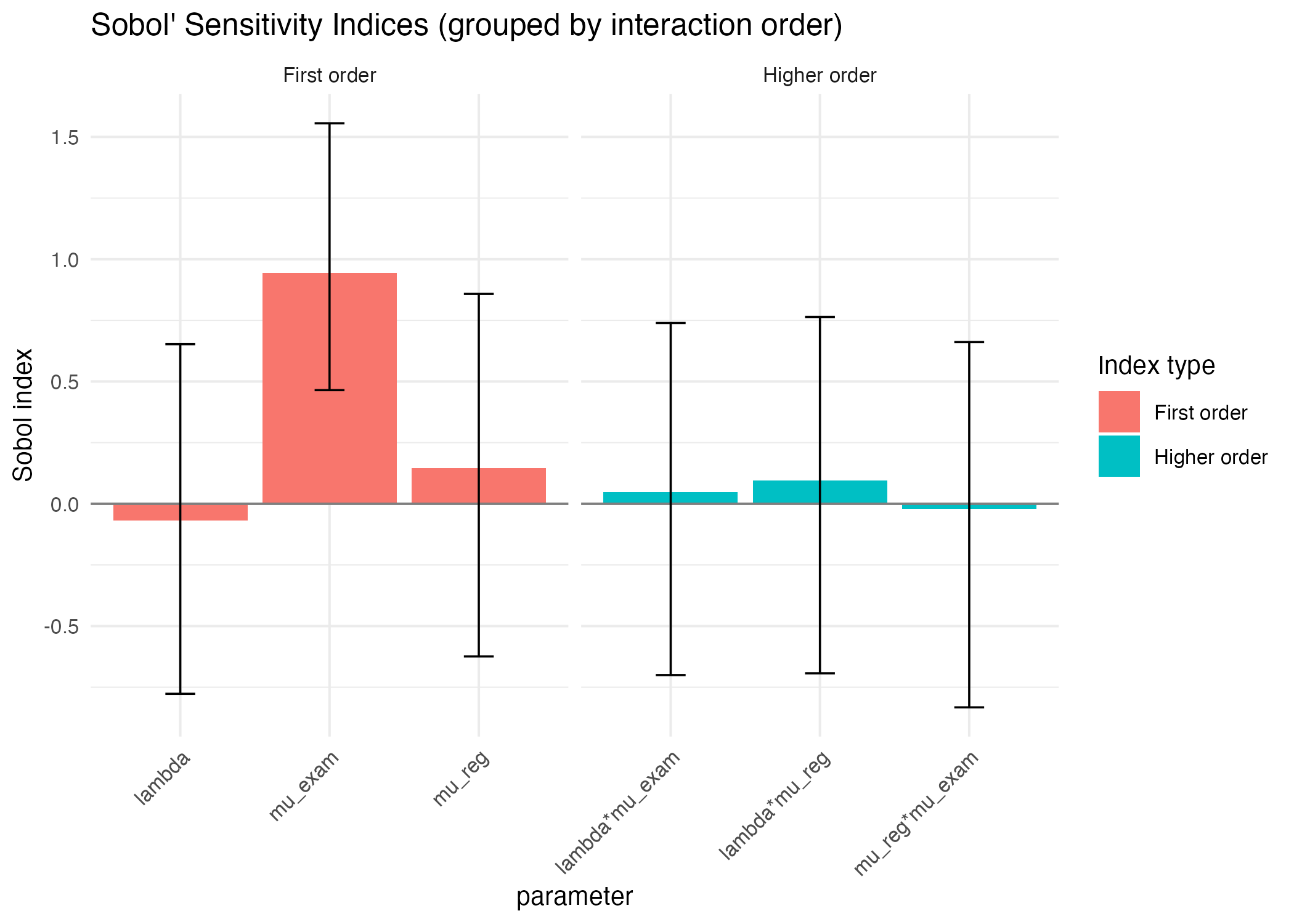
print(sob_clinic)
#>
#> Call:
#> sobol(model = NULL, X1 = X1, X2 = X2, order = 2, nboot = 50)
#>
#> Model runs: 1400
#>
#> Sobol indices
#>                   original        bias std. error  min. c.i. max. c.i.
#> lambda         -0.06917129 -0.01456138  0.4425323 -0.7768860 0.6526977
#> mu_reg          0.14549298  0.02817958  0.3568214 -0.6241805 0.8582114
#> mu_exam         0.94350070 -0.03795032  0.2581954  0.4647090 1.5558301
#> lambda*mu_reg   0.09415805  0.01032690  0.4447800 -0.6930579 0.7638910
#> lambda*mu_exam  0.04811807  0.01390153  0.4365342 -0.7003076 0.7390800
#> mu_reg*mu_exam -0.02079743  0.01079563  0.4448869 -0.8323448 0.6611365
Sobol4R::autoplot(sob_clinic)